


Hi Giuseppe,Originally Posted by gibasse

Thrust refers to 2D Thrust.
Regarding secondary positions using the 20DMF, I did not back-test such ideas using the 20DMF.
The 20DMF is only a market direction model. It can be used to trade broad market indexes such as SPY or IWM.
Although I trade it using double leveraged intruments, I do not advise using leverage.
I would trade either IWM or SPY depending on the US$/Euro trend/balance. These days, since the problems are located in Euro, a strong US$ would favor trading IWM on long signals and SPY on short signals.
The 20DMF has been used every day since March 2009. It has evolved with improvements whenever necessary.
Because I run the model before market opens, I take the day's close as a entry/exit reference price.
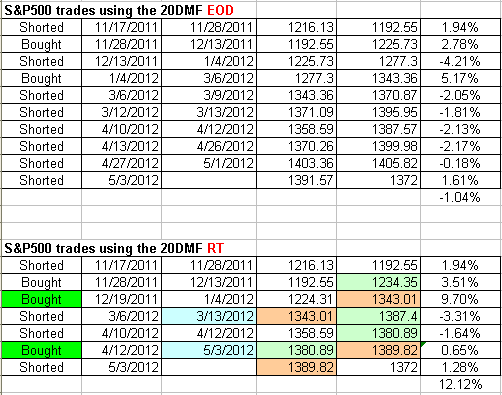
Taking the following day's open would slightly degrade the results, but not much. Also, there has been a 20DMF RT available for some time now to dual robot subscribers. Hence, the RT signals are available before market closes.
Unfortunately, we do not have the minute database ready for back-testing of RT signals before November 2011. However, since end of last year, the RT signals have performed slightly better than the EOD, which has been hit by consecutive whipsaws.
Below is a comparison table that I posted some days ago.
Pascal

 Reply With Quote